|
|||||||||
| |||||||||
  Pāda Yātrā or Foot Pilgrimage in modern times
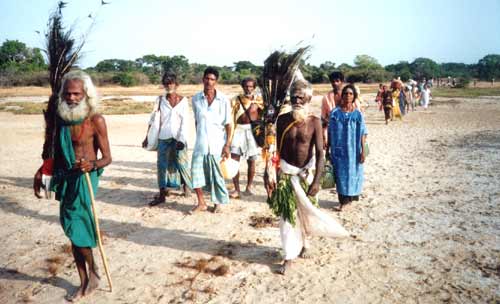
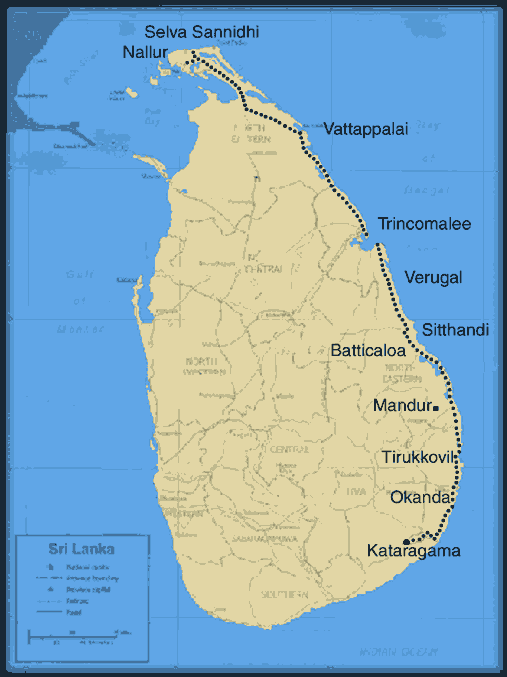
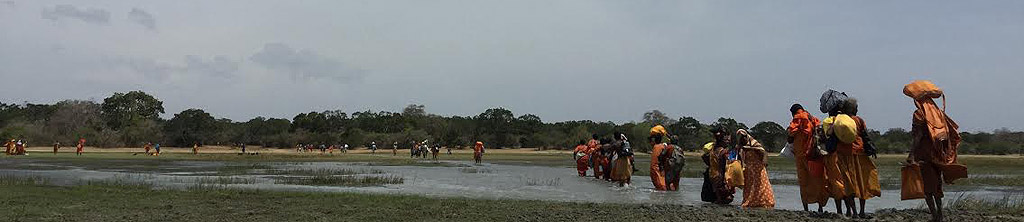
Traditional foot-pilgrimage or Pāda Yātra is not, as many people believe, a peace march, but an annual reenactment of espisodes related as legend and myth about Kataragama. Simple, ordinary people who say they have received a 'call', take part in this marathon walk. Leaving everything behind but a bundle of essentials, they experience the homeless life of a beggar or religious recluse. Deep lessons about the paradoxes of life are driven into them in a sustained act of self-denial. Sleeping and living outside, under trees and in shrines and temples; seldom knowing from where their next meal will come, braving death from animal attacks and worse in recent times; seldom knowing from where their next meal will come; braving death from animal attacks and worse in recent times; these are the factors of Pāda Yātra that make it such an intense spiritual opportunity for those who receive the 'call'. On June 11, 1990, hundreds of devotees began the 45-days Pāda Yātra from Mullaitivu to Kataragama. However, the outbreak of fighting on that very day resulted in the disruption of the pilgrimage. Although some pilgrims kept trying for as long a four weeks even under war conditions, nearly all had to turn back and did not reach Kataragama at all. In 1991, despite still unsettled conditions, hundreds more including a few western pilgrims joined the annual Pāda Yātra. Senior devotee Sella Swamigal, who formally accepted the emblematical Vēl or lance from retiring Pāda Yātra master Muttukumar Vel Swami, led the advance party from Varrāpalai Kaņņaki Amman temple on May 28. As late as the sixteenth century, so many Muslim bāwās and Hindu swāmis used to come through Jaffna on their way to Kataragama that the Portuguese colonial authorities, fearing a covert threat to their regime, decided to seal off the ancient pilgrimage route from the Asian mainland. The Katira Malai Kārai Yātirai or 'coastal pilgrimage to the Shining Peak' has thus at times passed into onscurity but has always managed to survive over the centuries down to the present day. In the 1970's the annual two-month walk from Jaffna to Kataragma used to attract over thousand of the faithful from Jaffna alone who would fill every village along the way with cries of Harō-Harā!, the hallelujah chorus of Kataragama devotees. But ethnic disturbances brought favourable conditions to an abrupt cessation in 1983 with acts of violence upon Pāda Yātra pilgrims. In 1988 the newly formed Kataragama Devotees Trust rallied national support and recognition for the few brave devotees who answered the call of veteran pilgrim Vel Swami (72) for devotees to resume the ancient tradition. In 1988 and 1989, pilgrims managed to walk from Mullaitivu to Kataragama even in tense and often dangerous 'peace' maintained by the Indian Peace-Keeping Force under the terms of the 1987 Indo-Sri Lanka Peace Accord. But in 1990 with the departure of Indian troops open warfare broke out on the very day (June11) that the Pāda Yātra also began. Minefields and battle zones blocked every route for mostly, the elder pilgrims, and eventually all had to turn back, each left to ponder the mystery of their Lord's strategy. The spiritual legacy of Kataragama has always been passed
down in the form of the participants' own inner illumination
(katir) and delight (kāma), assuming many humble guises along the way just
as the Pada Yatra pilgrims still do. No one to this day - whether
Sri Lankan or foreign - has ever plumbed the full depth of
Kataragama's wellspringof spiritual life. But many are quietly exploring it for themselves.
|